
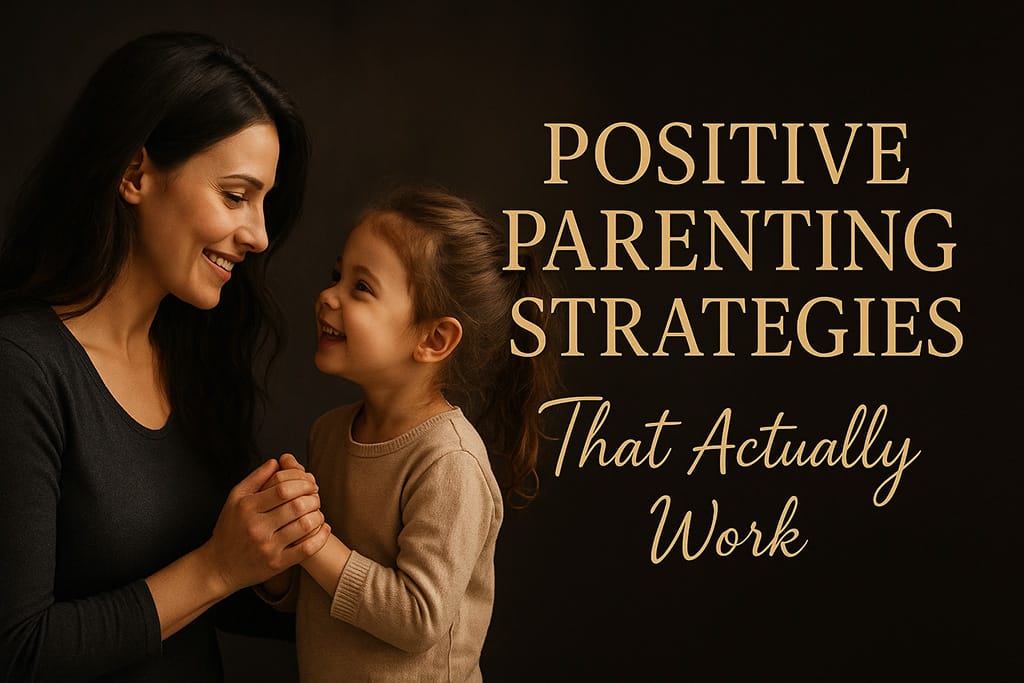
Proven Approaches for Raising Confident and Happy Children
Positive Parenting Strategies That Actually Work – Parenting is a dance — a tender, imperfect, and ever-changing rhythm of love, patience, and learning. Some days feel like sunshine, filled with giggles and tiny victories. Other days feel heavy, when exhaustion takes over and doubts whisper, “Am I doing enough?”
If you’ve ever felt that way, you’re not alone. Millions of women across the world — from New York to Nairobi, from London to Lahore — are searching for a kinder, calmer way to raise their children. And that’s exactly where Positive Parenting Strategies shine.
These aren’t magic tricks or strict rules. They’re gentle philosophies rooted in connection, respect, and mindfulness. They remind us that parenting isn’t about perfect control — it’s about genuine connection.
🌿 What Are Positive Parenting Strategies?
At their core, Positive Parenting Strategies are about guiding children through love instead of fear.
It’s about shifting from “How do I stop this behavior?” to “What does my child need right now?”
Instead of punishing mistakes, positive parenting encourages understanding them. Instead of demanding obedience, it nurtures cooperation. Children raised in this environment don’t just behave better — they feel better, and as a result, they grow with confidence, empathy, and inner strength.
This approach has deep roots in modern psychology and child development research. When kids feel safe, seen, and supported, their brains develop stronger emotional control and higher self-esteem.
And that, truly, is the goal — to raise not just well-behaved kids, but emotionally intelligent human beings.
💛 1. Connection Comes Before Correction
One of the golden rules of Positive Parenting Strategies is this: connection always comes first.
Before correcting behavior, build an emotional bridge.
When your little one spills milk, breaks a toy, or throws a tantrum, pause. Breathe. Then kneel down to their level and connect with their world.
Say softly, “I see you’re upset. That was your favorite cup, wasn’t it?”
This moment of empathy is far more powerful than a scolding. Children who feel understood are naturally more willing to listen, learn, and cooperate.
Try this: Dedicate 10 minutes each day as “special time.” Let your child choose the activity — coloring, dancing, building blocks — and be fully present. No phone. No multitasking. Just love.
🌸 2. Empathy Over Anger
Every meltdown tells a story. Behind every scream or refusal is a feeling your child doesn’t yet know how to manage.
Positive Parenting Strategies teach us to meet anger with empathy, not frustration.
When a child yells, instead of saying “Stop shouting!” try saying,
“You sound upset. Do you want to tell me what happened?”
By naming their emotions, you teach them to understand and regulate their own feelings. You become their emotional compass — calm, steady, loving.
Over time, this emotional modeling builds resilience and trust. Your child learns that mistakes don’t define them, and that home is always a safe place to fall.
🌼 3. Setting Loving Boundaries
Gentle doesn’t mean permissive. Love needs structure to thrive.
That’s why one of the most vital Positive Parenting Strategies is setting clear boundaries with kindness.
Children crave consistency — it helps them feel secure.
When you say “No screen time before homework,” explain why. Help them see that rules aren’t punishments; they’re acts of care.
Boundaries wrapped in empathy sound like:
“I know you want to play longer, but it’s bedtime now so you can wake up happy for school.”
This combination of warmth and firmness teaches responsibility — not out of fear, but out of love.
☀️ 4. Positive Reinforcement Works Wonders
Kids blossom when their efforts are noticed. A simple “I love how you tried your best” can motivate more than any lecture ever could.
With Positive Parenting Strategies, focus on praising effort, not just results.
Say “You worked really hard on that drawing!” instead of “You’re such a good artist.”
This teaches a growth mindset — the belief that success comes from persistence, not perfection.
Positive feedback builds a child’s self-confidence, emotional stability, and inner motivation — qualities that last far beyond childhood.
🌺 5. Teach, Don’t Punish
Punishment might stop a behavior temporarily, but it rarely teaches why it was wrong.
Instead, use mistakes as teaching moments.
For instance, if your child forgets their homework, help them brainstorm solutions instead of scolding them.
Ask: “What can we do next time to remember?”
This problem-solving mindset — a core part of Positive Parenting Strategies — nurtures responsibility and critical thinking. It teaches children that every action has a consequence, but also an opportunity to grow.
Recommended Reading
What to Expect During Each Trimester of Pregnancy
🌷 6. Model What You Want to See
Children don’t become what you say — they become what you show.
If you want respect, show respect. If you want calm, speak calmly.
When you practice self-control during stressful moments, your child learns that emotional regulation is possible. When you apologize sincerely after losing your temper, they learn humility and forgiveness.
Positive Parenting Strategies aren’t about being perfect — they’re about being present and real.
Remember: every calm breath, every gentle word, every hug during chaos — it all matters more than you realize.
🌻 7. Create Daily Routines That Ground Your Family
Structure brings peace. Children thrive on predictability because it helps them understand what’s coming next.
Morning routines, bedtime rituals, even family dinners — these are anchors in a child’s world.
Use Positive Parenting Strategies to turn routines into moments of connection:
- Read a story before bed every night
- Share “one good thing” from the day at dinner
- Hug goodbye before school — even on rushed mornings
Tiny rituals build a sense of belonging and emotional stability that children carry for life.
🌈 8. Care for Yourself, Too
You can’t pour from an empty cup. One of the most overlooked Positive Parenting Strategies is self-care.
Parenting is emotional labor — and you deserve rest, support, and compassion.
Take time to recharge. Drink your coffee slowly. Call a friend. Breathe deeply before responding when chaos erupts.
When you nurture your own emotional health, you show your children what balanced adulthood looks like. They learn that love includes caring for oneself, too.
🌹 Why Positive Parenting Strategies Truly Work
Because they are built on respect, understanding, and love — not control.
Children raised with these principles don’t need to be “managed.” They learn to manage themselves.
They don’t just behave well because they fear consequences — they choose kindness because they understand it.
They don’t just listen because you’re in charge — they listen because they trust you.
And that trust is the heart of parenting that lasts a lifetime.
💖 Final Thoughts: The Gentle Power of Love
Every parent stumbles. Every mother cries in the dark sometimes.
But the beauty of Positive Parenting Strategies is that they remind you — you don’t need to be perfect to be powerful. You just need to be present.
Your calm voice teaches peace.
Your empathy teaches compassion.
Your patience teaches strength.
So, take a breath. You’re doing better than you think.
And with every small act of love, you’re shaping a world that’s kinder, wiser, and more connected — one child at a time.
Recommended Reading