
digital detox for family well being

Reclaiming Family Balance in a Screen-Saturated World digital detox for family well being has quietly become one of the most emotionally charged conversations inside modern homes. It rarely starts as a crisis. It begins subtly — a parent answering emails during dinner, a child scrolling while half-listening, a shared couch filled with people but not presence. The house is full, yet connection feels diluted. This tension doesn’t announce itself loudly; it hums in the background of everyday routines until something feels off, unnamed, and unresolved. What makes this moment complex is not technology itself, but how invisibly it reshapes family rhythms. Screens slip into spaces once reserved for conversation, boredom, disagreement, and intimacy. The goal of a digital detox for family well being is not rejection or nostalgia — it is recalibration. It is the decision to notice what has quietly shifted and to restore balance without moral panic or rigid rules. ✨💫 Why Family Life Feels Fuller — and Emptier — at the Same Time Families today spend more hours together than previous generations in many measurable ways, yet emotional availability has thinned. Meals are eaten side by side, but attention is fragmented. Even shared leisure often unfolds in parallel digital worlds. A digital detox for family well being responds to this paradox, acknowledging that proximity does not automatically create connection. The challenge is subtle. Devices promise efficiency, calm, and entertainment, yet often introduce a low-grade tension. Conversations are punctured. Eye contact becomes optional. Silence, once fertile, now demands filling. Children notice these shifts long before they articulate them. Adults sense it too, often as guilt layered beneath convenience. What complicates matters further is that families rarely discuss screen use in emotional terms. It becomes logistical: time limits, parental controls, schedules. The emotional undercurrent — longing for attention, frustration at being interrupted, fear of missing out — stays unspoken. This is where most attempts at change quietly fail. ✨💫 The Hidden Emotional Cost of Constant Connectivity A digital detox for family well being is often framed as a productivity or mental health tool, but its deepest impact is relational. When attention is continuously divided, emotional attunement weakens. Small moments of connection — shared jokes, spontaneous questions, gentle disagreements — are lost not dramatically, but cumulatively. Parents often underestimate how deeply children internalize divided attention. A glance at a phone during a story or conversation sends a message that competes with words. It is not about blame; it is about awareness. Adults, too, experience erosion — conversations feel less satisfying, patience shortens, and rest becomes less restorative. This emotional thinning is rarely acknowledged because it doesn’t look like dysfunction. Homes remain functional, schedules intact, achievements celebrated. Yet something essential feels quieter. A digital detox for family well being creates space to hear that quiet again. Recommended Reading: How to Promote Family Health: A Complete 2026 Wellness Why Common Digital Detox Advice Rarely Works at Home Many families attempt a digital detox for family well being through rules borrowed from productivity culture: screen-free hours, device bans, strict quotas. These strategies often fail not because they are wrong, but because they ignore emotional dynamics. Rules imposed without shared understanding create resistance. Children perceive hypocrisy when adults exempt themselves. Teenagers interpret sudden restrictions as control rather than care. Even younger children sense when rules feel reactive instead of intentional. Another overlooked issue is timing. Families often introduce limits during moments of frustration — after conflict, exhaustion, or guilt. In those moments, screens become symbolic enemies rather than tools needing recalibration. Sustainable change requires emotional neutrality, not urgency. What works instead is framing a digital detox for family well being as a shared experiment rather than a correction. When families observe together — noticing moods, conversations, energy levels — screens lose their moral charge and become negotiable. ✨💫 Redefining “Detox” Without Drama or Deprivation The word “detox” suggests extremes, but in family life, extremes rarely last. A digital detox for family well being succeeds when it is designed as a gentle shift rather than a rupture. This may look like reclaiming specific moments rather than entire days. Morning transitions, mealtimes, bedtime routines — these are emotional anchors. Protecting them from digital intrusion creates disproportionate benefits. Families often discover that they do not miss screens as much as anticipated when emotional needs are met elsewhere. Importantly, detox does not mean constant engagement. It means allowing boredom, quiet, and unstructured time to exist again. These states often feel uncomfortable initially, especially for children accustomed to stimulation. Yet boredom is where creativity, negotiation, and self-regulation quietly develop. A digital detox for family well being respects these processes rather than rushing to fill every pause. The Role of Adults: Modeling Without Martyrdom One of the most uncomfortable truths about a digital detox for family well being is that children mirror what they observe more than what they are told. Adults often carry unspoken resentment about their own screen habits — work demands, social expectations, exhaustion — and this ambivalence leaks into family dynamics. Modeling does not require perfection. It requires visibility. When adults narrate choices — putting a phone away during conversation, acknowledging distraction, choosing presence — children learn discernment rather than obedience. Equally important is avoiding martyrdom. Overcorrecting by demonizing screens or portraying withdrawal as sacrifice creates tension. A digital detox for family well being works best when it feels like a gain rather than a loss — more laughter, more ease, more shared attention. ✨💫 Micro-Moments That Quietly Transform Family Atmosphere The most effective shifts are often small. A digital detox for family well being lives in micro-moments rather than grand declarations. A phone left outside the bedroom changes sleep quality and morning tone. A shared playlist during dinner replaces scrolling without confrontation. A designated charging spot reduces passive checking. These gestures signal intention without policing. Families often notice unexpected outcomes: conversations deepen, conflicts surface earlier rather than simmering, emotions feel closer to the surface. This can feel destabilizing at first. Screens often
Navigating Friendships as an Adult Woman

Managing Female Friendships in Adulthood Navigating friendships as an adult woman often feels far more complex than it did in earlier years, even though no one warns you about this shift. Friendships no longer form effortlessly through proximity or routine; they now exist alongside careers, emotional labor, changing priorities, unspoken expectations, and the quiet weight of adulthood itself. What once felt spontaneous can begin to feel intentional, even fragile. And yet, these relationships remain deeply essential. Adult friendships are rarely about convenience. They are about resonance. About finding people who understand the version of you that has evolved—sometimes quietly, sometimes painfully—over time. Navigating friendships as an adult woman requires emotional intelligence, discernment, and a willingness to accept that not every connection is meant to last forever. ✨✨✨ Why Adult Friendships Feel Emotionally Heavier As women grow older, friendships tend to carry more emotional nuance. Conversations are layered with history, shared vulnerability, and unspoken context. There is often less time, but more meaning attached to each interaction. Unlike younger years, adult friendships are shaped by competing responsibilities. Work stress, romantic partnerships, caregiving roles, and personal growth all influence availability and emotional presence. A delayed reply or canceled plan can feel personal—even when it isn’t. Navigating friendships as an adult woman means learning to interpret absence with generosity, while still honoring personal boundaries. Emotional maturity lies in recognizing when distance reflects circumstance rather than disinterest. 💫💫💫 The Myth of Effortless Longevity There is a common belief that “real” friendships should last forever without effort. In reality, longevity alone does not define depth. Many adult friendships fade not because of conflict, but because alignment quietly dissolves. Women often hold onto friendships out of loyalty, shared history, or fear of loss, even when the relationship no longer feels reciprocal. This creates emotional friction—connection without nourishment. Navigating friendships as an adult woman includes the difficult acceptance that some relationships are seasonal. Letting go is not betrayal; it is recognition. ✨✨✨ Recommended Reading: Realtionship Issues for Women When Growth Creates Distance Personal growth can subtly reshape friendships. As women evolve, priorities shift. Conversations change. Tolerance for certain dynamics diminishes. This growth can create distance, especially when one person changes faster or in a different direction. The tension often remains unspoken, expressed instead through reduced contact or emotional withdrawal. Navigating friendships as an adult woman requires honesty—with oneself first. Growth does not require permission, but it does require compassion for those adjusting to change. 💫💫💫 The Unspoken Rules Women Feel Pressured to Follow Women are often conditioned to be accommodating friends. To listen endlessly. To avoid confrontation. To prioritize harmony over truth. These unspoken rules can make friendships emotionally imbalanced. Resentment builds quietly when needs go unmet or boundaries are ignored. Over time, this erodes trust. Navigating friendships as an adult woman means redefining what kindness looks like. Sometimes, kindness is clarity. Sometimes, it is saying no without apology. ✨✨✨ Adult Friendship and Emotional Labor One of the least discussed aspects of adult friendships is emotional labor. Who initiates? Who checks in? Who remembers important moments? Who absorbs emotional weight? Imbalances often develop slowly. One person becomes the listener, the supporter, the emotional anchor. While this role can feel meaningful, it becomes draining when unreciprocated. Navigating friendships as an adult woman involves recognizing when emotional labor is shared—and when it is silently expected. 💫💫💫 When Conflict Feels Riskier Than Silence Many adult women avoid addressing conflict in friendships, fearing loss or awkwardness. Silence feels safer than honesty. But unresolved tension does not disappear; it reshapes the relationship. Distance replaces intimacy. Politeness replaces trust. Navigating friendships as an adult woman means understanding that respectful conflict can deepen connection, while avoidance slowly weakens it. ✨✨✨ The Role of Vulnerability in Adult Connections Adult friendships often deepen through vulnerability—but vulnerability feels riskier with age. There is more to lose. More history. More fear of being misunderstood. Some women withhold parts of themselves to maintain stability, presenting only curated versions of their inner world. Over time, this creates emotional distance. Navigating friendships as an adult woman includes choosing when and where vulnerability feels safe—and honoring that choice without pressure. 💫💫💫 Why Comparing Friendships Is Emotionally Damaging Social visibility makes comparison inevitable. Other women’s friendships appear effortless, intimate, constant. Reality is rarely so polished. Comparing friendships often leads to unrealistic expectations and unnecessary dissatisfaction. Every relationship has its own rhythm, limitations, and emotional language. Navigating friendships as an adult woman requires releasing comparison and focusing on emotional quality rather than outward appearance. ✨✨✨ Friendships That No Longer Fit—but Still Matter Some friendships outgrow daily relevance but retain emotional significance. These connections may not involve frequent contact, yet still carry warmth and mutual respect. Letting friendships change form can feel like loss, but it can also feel like relief. Not every meaningful relationship must be maintained in the same way forever. Navigating friendships as an adult woman includes allowing relationships to evolve naturally, without forcing proximity where it no longer fits. 💫💫💫 Making Space for New Friendships Forming new friendships in adulthood can feel surprisingly vulnerable. Social circles solidify. Schedules tighten. Rejection feels heavier. Many women hesitate to pursue new connections, fearing awkwardness or emotional fatigue. Yet meaningful friendships rarely appear without initiative. Navigating friendships as an adult woman involves staying open—without urgency. New connections flourish through consistency, not pressure. ✨✨✨ The Importance of Shared Values Over Shared History Shared history can bond people, but shared values sustain them. As women mature, alignment around boundaries, communication styles, and emotional expectations becomes more important than nostalgia. Friendships rooted in mutual respect adapt more easily to change. Those based solely on history often struggle. Navigating friendships as an adult woman means choosing relationships that support who you are now, not only who you used to be. 💫💫💫 Boundaries as a Form of Care Boundaries are often misunderstood as distance. In reality, they protect intimacy. Clear boundaries prevent resentment and preserve emotional energy. Women frequently struggle to enforce boundaries in friendships, fearing they
Finding Purpose as a Woman

Discovering Meaning in a Woman’s Life Finding purpose as a woman is often described as a moment of clarity, a quiet inner click where everything finally makes sense. Yet in real life, it rarely arrives as a single revelation. It usually unfolds slowly, between unfinished plans, shifting priorities, and subtle emotional negotiations that don’t fit neatly into motivational quotes. Purpose, for many women, is not something discovered once and protected forever; it is something continually shaped, questioned, and redefined. For women navigating modern life, purpose is often entangled with expectation. Careers evolve, relationships change, bodies age, and ambitions mature. What once felt essential can suddenly feel borrowed. What once seemed optional can begin to feel urgent. This is where the true complexity of finding purpose as a woman begins—not in dramatic reinvention, but in the quiet reassessment of what still feels honest. ✨✨✨ Why Purpose Feels More Complicated Than It Sounds The conversation around purpose often assumes stability. A clear calling. A linear journey. But women’s lives rarely move in straight lines. Purpose is frequently interrupted by caregiving roles, cultural pressures, emotional labor, and invisible responsibilities that shape daily choices. Many women reach points where external success doesn’t translate into internal fulfillment. A respected role, a full calendar, or even admiration from others can coexist with a lingering sense of misalignment. This contradiction is rarely discussed openly. It creates guilt: Why don’t I feel satisfied when I’m supposed to be? Finding purpose as a woman often starts by acknowledging this tension rather than rushing to resolve it. Purpose does not always demand more effort; sometimes it requires more honesty. 💫💫💫 The Quiet Loss of Self That Happens Gradually Purpose is often lost in subtle ways. Not through failure, but through adaptation. Saying yes too often. Prioritizing harmony over truth. Becoming highly competent at roles that no longer reflect inner values. Many women become experts at functioning while feeling disconnected. Days are productive, yet emotionally flat. Achievements accumulate, but excitement fades quickly. This emotional neutrality is frequently mistaken for maturity, when it may actually be a signal of suppressed desire. Finding purpose as a woman involves noticing these signals without judgment. Emotional numbness, recurring frustration, or vague restlessness are not flaws—they are information. ✨✨✨ Recommended Reading: Women’s Confidence in the Workplace Why Common Advice Rarely Works in Real Life Advice around purpose often sounds inspiring but fails in practice. “Follow your passion.” “Do what you love.” These phrases assume access—time, money, confidence, and emotional safety. Many women don’t lack passion; they lack space to explore it without consequence. Real life introduces constraints. Financial responsibility. Family dynamics. Fear of disappointing others. Cultural expectations around femininity and success. Purpose must exist within these realities, not in denial of them. Finding purpose as a woman is less about abandoning responsibilities and more about renegotiating relationships—with work, with others, and with oneself. 💫💫💫 Purpose Is Not Always Loud or Public There is a misconception that purpose must be visible. Something impressive. Something others can easily name. But many women find their deepest sense of purpose in areas that receive little validation. Purpose can live in how boundaries are set, how creativity is protected, or how personal growth is prioritized quietly. It can exist in choosing depth over speed, alignment over applause. Finding purpose as a woman often means releasing the need for it to look impressive and allowing it to feel meaningful instead. ✨✨✨ The Role of Identity Shifts in Women’s Lives Women experience identity transitions frequently. Career changes, motherhood, loss, relocation, aging, emotional awakenings. Each shift challenges previously held definitions of self. Purpose can feel destabilized during these transitions—not because it is gone, but because the framework supporting it has changed. Many women mistake this discomfort for failure, when it is actually recalibration. Finding purpose as a woman during these moments requires patience. Identity is not rebuilt overnight. It emerges through experimentation, reflection, and sometimes discomfort. 💫💫💫 The Emotional Labor Behind Purpose Women are often taught to prioritize emotional availability. Being supportive, responsive, accommodating. While these traits can be strengths, they can also dilute personal direction if unbalanced. Purpose cannot survive on leftovers. When energy is constantly directed outward, inner clarity weakens. Many women struggle to articulate what they want simply because they are rarely asked—or allowed—to want openly. Finding purpose as a woman includes reclaiming emotional bandwidth. Protecting solitude. Allowing desire to exist without immediate justification. ✨✨✨ When Purpose Changes—and Why That’s Not a Failure One of the most overlooked truths is that purpose evolves. What felt meaningful at twenty may feel restrictive at forty. This shift is often framed as inconsistency, especially for women conditioned to prove reliability. In reality, evolving purpose reflects growth. Life experience sharpens discernment. Values deepen. Tolerance for misalignment decreases. Finding purpose as a woman means allowing change without self-betrayal. Honoring past versions of the self without being confined by them. 💫💫💫 The Subtle Difference Between Obligation and Meaning Many women live lives filled with obligation mistaken for purpose. Being needed can feel similar to being fulfilled—until exhaustion sets in. True purpose energizes, even when it’s challenging. Obligation depletes. The distinction becomes clearer when women ask not “Who depends on me?” but “What feels internally sustaining?” Finding purpose as a woman often begins with separating these two forces and choosing more consciously where energy flows. ✨✨✨ The Inner Voice That Often Gets Ignored Women are frequently socialized to doubt their intuition. To seek validation. To explain choices. Over time, this can mute the inner voice that signals alignment. Purpose becomes harder to access when intuition is consistently overridden. Rebuilding trust with that voice requires slowing down, noticing patterns, and respecting emotional responses. Finding purpose as a woman involves listening without immediately correcting or censoring oneself. 💫💫💫 Redefining Success on Personal Terms Mainstream definitions of success rarely account for emotional sustainability. Achievement without presence. Productivity without peace. Visibility without fulfillment. Many women reach milestones only to realize they’ve been chasing someone else’s metrics. Purpose cannot thrive
mindfulness benefits for women’s mental well being

The Positive Impact of Mindfulness on Women’s Mental Health mindfulness benefits for women’s mental well being are no longer discussed as a luxury reserved for retreats or quiet mornings with endless free time. They have become a quiet necessity woven into the background of modern female life — especially in a world that expects emotional intelligence, resilience, productivity, and beauty to coexist effortlessly. For many women, mental well-being is shaped less by dramatic events and more by the constant accumulation of small pressures: unspoken expectations, emotional labor, and the invisible responsibility of holding everything together. What makes mindfulness particularly relevant today is not its promise of calm, but its ability to meet women where they actually are — distracted, overextended, emotionally alert, and often running on unacknowledged fatigue. Rather than offering escape, mindfulness creates space within reality, allowing mental well-being to become flexible instead of fragile. Why Women Experience Mental Overload Differently Mental strain rarely announces itself loudly. More often, it appears as irritability without a clear reason, mental fog during simple decisions, or the feeling of being emotionally “on” long after the day ends. Women tend to internalize stress, absorbing emotional signals from their environment while continuing to perform competently on the surface. The mindfulness benefits for women’s mental well being emerge precisely because mindfulness interrupts this internalization loop. Instead of suppressing stress or reframing it prematurely, mindfulness allows emotions to be noticed before they harden into chronic tension. Many women discover that stress isn’t coming from a single source — work, relationships, or family — but from the constant switching between roles without psychological closure. Mindfulness offers a form of mental punctuation, allowing the nervous system to register transitions instead of blurring them together. The Quiet Emotional Labor That Goes Unnoticed ✨ Emotional labor isn’t just about caring for others. It includes anticipating needs, managing atmospheres, remembering details, and adjusting one’s emotional expression to maintain harmony. This ongoing awareness creates a mental load that rarely receives validation. One of the most understated mindfulness benefits for women’s mental well being is its ability to neutralize this silent accumulation. Mindfulness doesn’t eliminate emotional labor, but it changes how deeply it embeds itself. By observing emotions rather than immediately responding to them, women regain a sense of internal authorship over their mental space. Instead of absorbing every emotional cue as an obligation, mindfulness creates a pause — a moment where choice becomes possible again. When Traditional Self-Care Advice Falls Short Much of the wellness advice directed at women focuses on adding more tasks: journaling routines, morning rituals, evening resets. While well-intentioned, this approach often backfires, turning self-care into another performance metric. Mindfulness benefits for women’s mental well being precisely because it subtracts rather than adds. It doesn’t demand extra time, aesthetic perfection, or emotional optimism. It simply shifts attention — from constant doing to deliberate noticing. This is why mindfulness tends to succeed where productivity-based wellness fails. It works during imperfect moments: standing in line, lying awake at night, or noticing tension in the shoulders during a conversation that requires emotional diplomacy. Recommended Reading: Peace of Mind in Daily Life Women Mindfulness as Emotional Boundary-Setting 💫 Boundaries are often discussed as external actions — saying no, reducing commitments, creating distance. But many emotional boundaries are internal. They involve deciding how much emotional energy a situation deserves. Mindfulness benefits for women’s mental well being by strengthening this internal boundary system. When thoughts and emotions are observed rather than merged with identity, emotional reactions lose their urgency. A difficult interaction becomes an experience, not a verdict on self-worth. Over time, this practice softens emotional reactivity without numbing sensitivity — a balance many women struggle to achieve through willpower alone. The Relationship Between Mindfulness and Guilt Guilt is one of the most persistent emotional patterns affecting women’s mental health. Guilt for resting, for prioritizing personal needs, for not being available enough — even when exhaustion is undeniable. Mindfulness doesn’t argue with guilt. It observes it. And that observation is transformative. By noticing guilt as a mental event rather than a moral truth, mindfulness benefits for women’s mental well being extend into self-compassion. Guilt loses its authority when it is seen clearly, without resistance or justification. This subtle shift allows women to make decisions based on capacity rather than obligation. How Mindfulness Changes the Inner Dialogue Many women are familiar with an internal voice that narrates shortcomings with relentless precision. This voice often sounds practical or motivating, but over time it erodes emotional stability. One of the most powerful mindfulness benefits for women’s mental well being is the softening of this inner narration. Thoughts are no longer treated as instructions or judgments, but as passing mental phenomena. This doesn’t mean negative thoughts disappear. It means they stop defining reality. With consistent awareness, women begin to recognize how often the mind exaggerates urgency, responsibility, and self-criticism — especially during periods of fatigue. Mindfulness and the Nervous System Connection Mental well-being is inseparable from the nervous system. Chronic alertness, shallow breathing, and constant anticipation keep the body in a subtle stress state that the mind interprets as normal. Mindfulness benefits for women’s mental well being by restoring communication between body and mind. Noticing breath patterns, muscle tension, or subtle discomfort sends signals of safety to the nervous system — signals that don’t require explanation or justification. This physiological grounding is particularly important for women who appear emotionally functional but feel internally depleted. Over time, mindfulness cultivates a sense of internal steadiness that doesn’t rely on external stability. Emotional Clarity Without Emotional Suppression There’s a misconception that mindfulness encourages emotional detachment. In reality, it sharpens emotional clarity. Mindfulness benefits for women’s mental well being because it allows emotions to be felt fully without becoming overwhelming. Sadness is experienced without collapse. Anger is acknowledged without escalation. Anxiety is noticed without immediate problem-solving. This emotional honesty prevents the buildup of unresolved feelings that often surface later as burnout or emotional numbness. Women often report feeling
Productivity Challenges for Women
The Hidden Struggles Behind Women’s Productivity productivity challenges for women are rarely about a lack of ambition, discipline, or intelligence. They are quieter, more layered, and often embedded in the everyday structures women move through without naming them. Productivity, for women, is less a question of time management and more a negotiation — between visibility and exhaustion, expectation and capacity, ambition and emotional labor. In professional and personal spaces alike, the pressure to perform seamlessly often masks the reality of what it actually costs. What makes productivity challenges for women uniquely complex is not that women face obstacles — everyone does — but that many of these obstacles are contradictory. Women are encouraged to be decisive but accommodating, efficient but emotionally available, driven but endlessly flexible. The result is not failure, but friction: the slow erosion of focus, energy, and momentum that no planner or routine fully resolves. ✨ The Invisible Weight Behind Productivity Challenges for Women One of the most overlooked productivity challenges for women is the invisible weight of responsibility that accompanies even the most progressive environments. It’s the unspoken expectation to remember birthdays, smooth tensions, anticipate needs, and absorb emotional disruptions — all while delivering tangible results. This kind of labor doesn’t appear on task lists, yet it occupies cognitive space. A woman may sit down to work with a clear plan, only to find her attention fragmented by unresolved interpersonal dynamics, subtle self-monitoring, or the need to remain socially attuned. Productivity, in this context, becomes less about execution and more about containment. What often gets mislabeled as distraction is, in reality, overextension. The mind is not unfocused — it is over-occupied. When Efficiency Conflicts With Social Expectations Among the most persistent productivity challenges for women is the tension between efficiency and likability. Directness may save time, but it can also invite misinterpretation. Saying “no” may protect focus, yet it can quietly damage perceived warmth. Many women learn, early on, that productivity must be softened — delivered with explanations, reassurance, and emotional cushioning. This extra layer adds time, energy, and internal calculation to even simple tasks. The work gets done, but not without a psychological surcharge. In practice, this means women often complete the same workload as their peers, but with more relational navigation woven into each step. The calendar may look manageable, but the mental load tells a different story. 💫 Recommended Reading: How Women Can Accelerate Their Career Growth in 2026? The Myth of Multitasking and the Reality of Fragmentation Multitasking is frequently framed as a strength associated with women, yet it is also one of the most damaging productivity challenges for women. Switching rapidly between roles — professional, caregiver, partner, organizer — can feel efficient, but it fractures attention. Fragmentation doesn’t always feel like stress. Sometimes it appears as constant low-level alertness: checking messages between tasks, holding multiple timelines in mind, anticipating interruptions before they happen. Over time, this state erodes the kind of deep focus required for meaningful progress. What’s rarely acknowledged is that productivity thrives on containment — uninterrupted space, psychological safety, and permission to focus fully. Without these conditions, effort increases while output plateaus. Emotional Labor as a Productivity Tax Emotional labor is one of the most underestimated productivity challenges for women. It shows up in the way women manage reactions, defuse tension, and maintain harmony — often instinctively, often without acknowledgment. This labor is not optional. It is embedded in professional survival and social cohesion. However, it consumes energy that could otherwise fuel creative or strategic work. By the end of the day, many women feel drained without being able to point to a specific cause. The frustration lies not in doing emotional labor, but in doing it invisibly — while being measured solely on visible outcomes. Why Common Productivity Advice Often Misses the Mark Much of the advice surrounding productivity challenges for women assumes a neutral playing field. Wake up earlier. Set boundaries. Optimize your schedule. These suggestions sound reasonable, yet they often ignore the relational consequences women navigate when implementing them. Waking up earlier doesn’t eliminate emotional demands. Setting boundaries can create subtle backlash. Optimizing a schedule doesn’t reduce the mental effort of managing expectations. When advice fails to account for these realities, it can quietly reinforce self-blame rather than offer relief. What works in theory often collapses in lived experience — not because women are inconsistent, but because the advice itself is incomplete. ✦ ✦ ✦ The Productivity Cost of Constant Self-Monitoring Another rarely discussed productivity challenge for women is self-monitoring. From tone of voice to facial expression, from word choice to perceived competence, many women continuously assess how they are being received. This internal monitoring is not vanity; it is adaptive behavior shaped by experience. However, it divides attention. While part of the mind focuses on the task, another part scans for social signals, adjusting in real time. Over long periods, this split attention reduces efficiency and increases fatigue. The work may still be excellent, but it requires more effort than it should. Ambition Without Burnout: A Difficult Balance Productivity challenges for women are often intensified by ambition itself. Wanting more — growth, recognition, impact — can collide with the pressure to remain composed and accommodating. Many women push themselves not only to perform well, but to do so gracefully. Burnout, when it arrives, is frequently quiet. It doesn’t always look like collapse; sometimes it looks like numbness, procrastination, or a creeping loss of motivation. The danger lies in interpreting these signals as personal failure rather than structural strain. The Role of Mental Load in Daily Productivity Mental load is one of the most concrete yet least visible productivity challenges for women. It includes planning, anticipating, remembering, and coordinating — often across multiple domains of life. Even in environments where responsibilities are shared, women often remain the default holders of continuity. This means productivity is constantly interrupted by background processing: what’s next, what’s missing, what could go wrong. The result is a form
Sleep Improvement Tips for Women’s Hormones

Tips for Better Sleep and Hormonal Balance in Women Sleep improvement tips for women’s hormones rarely begin at bedtime. They usually start earlier — in the quiet exhaustion of mid-afternoon, in the way evenings feel heavier than they should, or in the familiar frustration of lying awake while the body feels tired but the mind refuses to slow. For many women, sleep is not simply about rest; it is where hormones either recover gently or unravel further. And when sleep suffers, the effects ripple outward — into mood, appetite, skin, focus, and emotional resilience. What makes sleep especially complex for women is that it is never just about habits. Hormonal shifts across the menstrual cycle, during periods of stress, or through perimenopause and menopause subtly reshape how the body responds to darkness, quiet, and routine. Understanding sleep, then, becomes less about forcing better nights and more about learning how the body signals its needs — and how modern life often interrupts them. ✨ When Sleep Disruption Is a Hormonal Signal, Not a Failure Many women internalize sleep problems as personal shortcomings: not disciplined enough, not relaxed enough, not doing “the right routine.” In reality, sleep disruption often reflects hormonal conversations happening beneath the surface. Estrogen plays a role in regulating body temperature and mood; progesterone has calming, sedative qualities. When these hormones fluctuate — especially in the second half of the cycle or during transitional life stages — sleep may feel lighter, more fragmented, or emotionally restless. Add stress hormones to the mix, and nights that once felt restorative can become unpredictable. Sleep improvement tips for women’s hormones work best when sleep issues are treated as information, not defects. The body is communicating, not malfunctioning. 💫 Why Common Sleep Advice Often Falls Short for Women Generic sleep advice tends to assume a neutral, predictable body. Women’s bodies are neither. Being told to “just go to bed earlier” ignores the hormonal reality of racing thoughts before a period. Advice to “avoid naps” doesn’t account for weeks when energy drops unexpectedly due to hormonal shifts. Even recommendations around exercise timing can feel unhelpful when cortisol levels are already elevated. Sleep improvement tips for women’s hormones must be flexible enough to adapt to these changes. What works beautifully one week may feel ineffective the next — and that variability is not a sign of failure, but physiology. ✨ Recommended Reading: Sexual Benefits of Zinc for Women The Evening Hours: Where Hormones Decide the Night For many women, the quality of sleep is decided long before the pillow is touched. The hours between late afternoon and bedtime quietly shape hormonal readiness for rest. Cortisol and the “Second Wind” A common experience is feeling exhausted all day, only to feel strangely alert at night. This often reflects cortisol patterns that remain elevated into the evening, especially after mentally demanding or emotionally charged days. When cortisol stays high, melatonin — the hormone that supports sleep onset — struggles to rise. Sleep improvement tips for women’s hormones often begin with downshifting, not sleeping harder. Gentle transitions, rather than abrupt stops, help signal safety to the nervous system. 💫 Light Exposure and Hormonal Timing Light is one of the most underestimated hormonal influences on sleep. Bright environments, screens, and overhead lighting can delay melatonin release, even when the body feels physically tired. For women sensitive to hormonal fluctuations, evening light exposure can amplify sleep difficulties — especially during phases when sleep is already fragile. Softening light after sunset, dimming overhead bulbs, and reducing screen intensity are not aesthetic choices; they are hormonal cues. Sleep improvement tips for women’s hormones often succeed not because of dramatic changes, but because of these subtle environmental shifts that the body interprets instinctively. ✨ Temperature, Comfort, and the Female Body Women’s sleep is closely tied to body temperature. Hormonal shifts can affect how warm or cool the body feels at night, sometimes unpredictably. A room that felt comfortable last month may suddenly feel stifling or cold. Creating a sleep environment that allows flexibility — breathable bedding, adjustable layers, airflow — supports deeper sleep by accommodating hormonal variation rather than resisting it. This is one of the most overlooked sleep improvement tips for women’s hormones: comfort is not indulgence, it is regulation. 💫 The Emotional Layer of Sleep Sleep is emotional. For women especially, nights often become the only quiet space where unresolved thoughts surface. Worries postponed during the day arrive in full clarity once external distractions disappear. Trying to silence the mind forcefully often backfires. What tends to work better is acknowledgment without engagement — letting thoughts exist without following them. Gentle rituals such as writing down lingering concerns or allowing a few minutes of intentional stillness can reduce nighttime mental intensity. Sleep improvement tips for women’s hormones recognize that emotional regulation and hormonal regulation are deeply intertwined. ✨ Food Timing and Sleep Quality While sleep advice often avoids discussing food, the body does not. Irregular eating patterns, skipped meals, or late, heavy dinners can all influence nighttime hormones. Blood sugar instability can trigger stress responses during sleep, leading to waking in the early hours or restless dreams. Conversely, overly restrictive eating may increase nighttime alertness as the body searches for energy. Sleep improvement tips for women’s hormones emphasize consistency over restriction. Balanced, timely nourishment supports smoother hormonal transitions into rest, even if meals are not perfect. 💫 Exercise: Supportive or Stimulating? Movement supports sleep — but timing and intensity matter. High-intensity activity late in the evening can elevate cortisol, delaying relaxation. On the other hand, gentle movement earlier in the day often improves sleep depth. Women frequently notice that their tolerance for evening workouts changes across the month. Honoring these shifts, rather than following rigid schedules, allows exercise to support sleep instead of competing with it. Sleep improvement tips for women’s hormones work best when physical activity feels energizing, not depleting. ✨ Recommended Reading: Balanced Diet for Female Hormones Routine Without Rigidity Routines help regulate circadian rhythms, but
Balanced Diet for Female Hormones
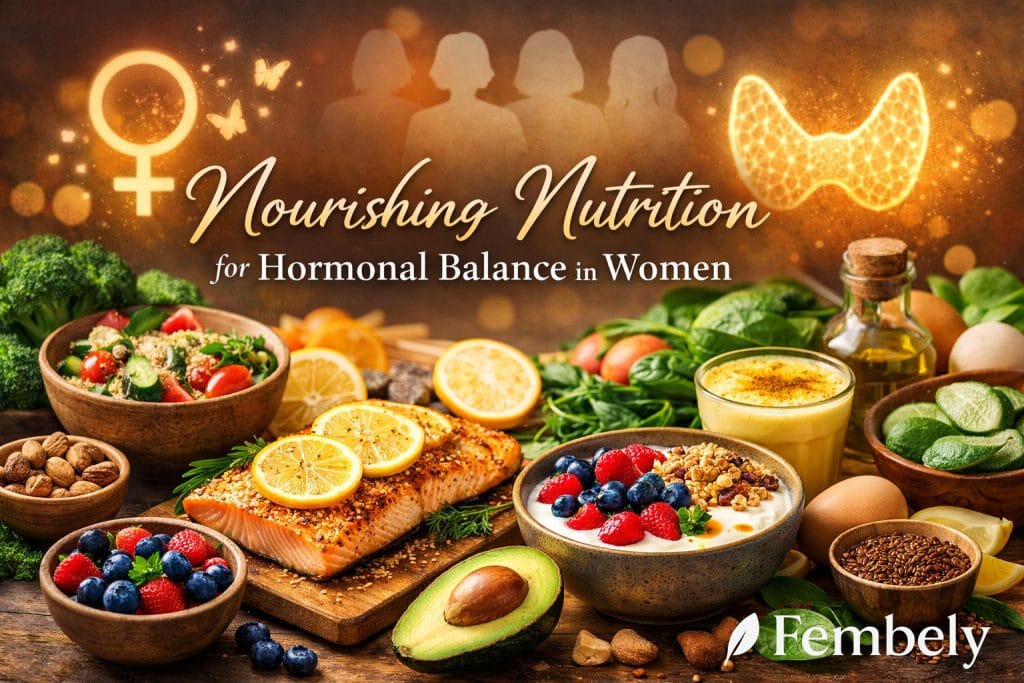
Nourishing Nutrition for Hormonal Balance in Women Balanced diet for female hormones is rarely discussed in the calm, realistic way women actually need. Too often, hormonal health is framed as something broken that must be fixed quickly — with rigid food rules, unrealistic meal plans, or a sense of quiet guilt when life inevitably interferes. In reality, female hormones respond less to perfection and more to consistency, rhythm, and emotional safety around food. What truly shapes hormonal balance is not one “clean” week or a sudden reset, but the daily negotiations between energy, stress, appetite, mood, and nourishment. A woman’s body does not operate on straight lines. Hormones rise and fall, appetite shifts subtly across the month, and emotional needs intertwine with physical ones. A balanced diet for female hormones must respect these fluctuations instead of fighting them. It must feel livable on busy mornings, comforting on exhausting evenings, and supportive during those quiet weeks when motivation dips without explanation. ✨ Why Hormonal Balance Is More About Rhythm Than Restriction Hormonal health is often misunderstood as something that demands control. In practice, control is usually what disrupts it. When eating becomes rigid — constant calorie tracking, fear of certain food groups, or long stretches of undereating — the body interprets scarcity. Female hormones are particularly sensitive to this signal. Cycles may become irregular, energy unstable, and emotional resilience thinner. A balanced diet for female hormones works not because it eliminates foods, but because it reassures the body that nourishment is reliable. Many women notice subtle signs long before anything feels “wrong”: afternoon crashes, cravings that feel louder than hunger, sleep that looks normal but doesn’t feel restorative. These are often early messages that nutritional rhythm is off — not dramatic failures, but gentle warnings asking for steadiness rather than discipline. 💫 The Hidden Hormonal Cost of Skipping Meals Skipping meals is often normalized, even praised. Busy schedules, delayed breakfasts, or the habit of “just grabbing coffee” can quietly destabilize hormones over time. Female hormones rely on consistent blood sugar to stay regulated. Long gaps between meals can trigger stress responses, leading to increased cortisol activity — a hormone that easily overshadows others when it remains elevated. This doesn’t always show up as anxiety; sometimes it looks like irritability, foggy thinking, or feeling emotionally flat. A balanced diet for female hormones does not demand large meals or constant eating. It asks for predictability. Even small, well-timed meals can restore hormonal trust. What matters is not how little one can eat, but how supported the body feels throughout the day. ✨ What to Eat and What to Avoid for a Balanced Diet for Female Hormones A balanced diet for female hormones focuses on stabilizing blood sugar, supporting natural hormone production, and reducing unnecessary stress on the body. Instead of extreme restriction, the goal is nourishment that feels steady, satisfying, and realistic. Foods to Eat for Hormonal Balance 1. Whole, slow-digesting carbohydrates Carbohydrates are essential in a balanced diet for female hormones because they help regulate cortisol and support reproductive hormones. Choose options that digest gradually to avoid energy crashes. Examples include whole grains, root vegetables, legumes, and fruits paired with protein or fat. 2. Quality protein at every meal Protein provides the building blocks for hormone signaling and helps maintain stable appetite throughout the day. Moderate portions spread evenly across meals are more supportive than very high-protein, low-carb patterns. 3. Healthy dietary fats Hormones are synthesized from fats. Including natural fat sources consistently helps the body feel safe enough to maintain hormonal balance. Fats also improve satiety and reduce sugar cravings. 4. Fiber-rich vegetables Vegetables support digestion and help the body process excess hormones efficiently. A variety of colors throughout the week matters more than eating large amounts at once. 5. Regular meals and snacks Timing matters just as much as food choice. Eating regularly supports blood sugar stability, which is foundational to any balanced diet for female hormones. ✨ Foods to Limit or Avoid Highly processed foods These often disrupt appetite signals and contribute to blood sugar swings, making hormonal balance harder to maintain. Excessive sugar on its own Sugar isn’t the enemy, but consuming it without protein or fat can increase hormonal stress responses. Very low-calorie or restrictive eating patterns Undereating is one of the most common reasons female hormones become irregular. Consistency matters more than “clean” eating. Skipping meals frequently Long gaps between meals can elevate stress hormones and interfere with natural hormonal rhythms. 💫 Sample 7-Day Balanced Diet for Female Hormones This example shows how a balanced diet for female hormones might look in real life. Portions should be adjusted based on hunger and lifestyle. Day 1 Breakfast: Whole-grain toast with eggs and vegetables Lunch: Grain bowl with legumes, greens, and olive oil Dinner: Baked protein, roasted vegetables, and carbohydrates Day 2 Breakfast: Yogurt with fruit, nuts, and seeds Lunch: Balanced salad with protein, grains, and dressing Dinner: Stir-fried vegetables with protein and rice Day 3 Breakfast: Oatmeal with berries and nut butter Lunch: Soup with beans, vegetables, and bread Dinner: Protein, sweet potatoes, and greens Day 4 Breakfast: Smoothie with protein, fruit, and fats Lunch: Wrap with protein, vegetables, and sauce Dinner: Pasta with vegetables and protein Day 5 Breakfast: Eggs, vegetables, and toast Lunch: Grain-based salad with fats and protein Dinner: Slow-cooked meal with carbohydrates Day 6 Breakfast: Yogurt bowl with grains and fruit Lunch: Leftovers with balanced macros Dinner: Comfort-style meal, eaten mindfully Day 7 Breakfast: Flexible, hunger-led breakfast Lunch: Nourishing meal out or at home Dinner: Light but satisfying balanced plate Carbohydrates: The Most Misunderstood Hormonal Ally Carbohydrates are frequently framed as optional or indulgent. For female hormones, they are neither. When carbohydrates disappear, hormones often react first. Low carbohydrate intake can interfere with signals that regulate ovulation, thyroid activity, and mood stability. This doesn’t mean every meal needs to revolve around them, but it does mean they cannot be treated as an afterthought. In a balanced diet for female hormones,
The Impact of Stress on Women: What No One Talks

How Stress Quietly Shapes Women’s Lives impact of stress on women is no longer a quiet undercurrent of modern life; it has become a defining texture of daily experience. It shows up in subtle ways first — a short temper in the morning, a heaviness in the body that sleep doesn’t resolve, a sense of constantly running behind even on calm days. For many women, stress is not a single dramatic event but a slow accumulation of emotional labor, invisible expectations, and internalized pressure to hold everything together with grace. What makes it particularly complex is that stress rarely announces itself clearly; it blends into ambition, care, responsibility, and even love. This is not a conversation about eliminating stress entirely — that promise is both unrealistic and unhelpful. Instead, understanding the impact of stress on women requires looking closely at how stress behaves differently in female lives, how it interacts with hormones, identity, and social roles, and why so much well-meaning advice misses the mark. ✨ The Quiet Weight Women Carry Without Naming It One of the most overlooked aspects of the impact of stress on women is how normalized it has become. Many women don’t describe themselves as “stressed” at all. They say they’re tired, busy, overwhelmed, or simply “fine.” Stress hides behind competence. There is a particular kind of pressure that comes from being the emotional anchor — at work, at home, in friendships. Women are often the ones remembering birthdays, smoothing tensions, noticing shifts in mood, and anticipating needs before they are spoken. None of this appears on a to-do list, yet it consumes real cognitive and emotional energy. Stress, in this form, is rarely explosive. It’s persistent. It hums in the background while life moves forward, making it harder to rest even when there is time to do so. 💫 Recommended Reading: Understanding Late-Onset Postpartum Depression Why Stress Feels Different in the Female Body The impact of stress on women cannot be fully understood without acknowledging how deeply it interacts with the body. Stress does not exist only in the mind; it moves through the nervous system, hormones, digestion, skin, and sleep patterns. Women often notice stress physically before they name it emotionally. It can appear as irregular sleep, digestive discomfort, skin changes, headaches, or unexplained fatigue. These signals are easy to dismiss as unrelated inconveniences, especially when life is busy. Over time, however, they form a pattern. What complicates matters is that women are often taught to override bodily discomfort — to push through, adapt, and continue functioning. This resilience is praised, but it comes at a cost. When stress is constantly overridden, it becomes chronic rather than situational.✨ Emotional Labor: The Stress That Doesn’t Clock Out Another central dimension of the impact of stress on women is emotional labor — the mental and emotional work of managing relationships, environments, and expectations. Unlike physical tasks, emotional labor rarely has a clear endpoint. It’s the internal calculation before speaking up. The emotional buffering during conflict. The responsibility of maintaining harmony, even at personal expense. This kind of stress is particularly draining because it often goes unrecognized — both by others and by the women carrying it. There is no external validation for effort that remains invisible, and that lack of acknowledgment can quietly amplify stress levels over time.💫 When Productivity Masks Exhaustion Modern culture often reframes stress as motivation. Being busy is equated with being valuable, and exhaustion is misinterpreted as dedication. Many women internalize this narrative early, learning to measure self-worth through output rather than well-being. Here, the impact of stress on women becomes paradoxical. Stress can initially sharpen focus and increase productivity, which reinforces the behavior that caused it. But this is not sustainable. Over time, clarity gives way to brain fog, motivation turns into resentment, and ambition becomes emotionally expensive. What’s often misunderstood is that burnout rarely arrives suddenly. It builds quietly beneath consistent achievement, especially when rest is treated as optional rather than necessary. ✨ The Social Expectation to “Handle It All” Stress does not develop in isolation. It is shaped by context — cultural, relational, and societal. Women are still widely expected to be adaptable, emotionally available, aesthetically composed, and professionally competent, often simultaneously. The impact of stress on women intensifies when these expectations conflict. For example, ambition may clash with caregiving roles, or self-care narratives may contradict financial or emotional realities. The stress does not come from failure, but from trying to meet incompatible standards without visible strain. This is why simplistic advice often falls flat. Telling women to “slow down” without addressing structural pressures can feel dismissive rather than supportive. 💫 Why Common Stress Advice Often Doesn’t Work Much of the mainstream conversation around stress management assumes that stress is a personal failure of organization or mindset. In reality, the impact of stress on women is frequently situational, relational, and systemic. Advice that focuses solely on individual habits — wake up earlier, plan better, stay positive — overlooks the complexity of lived experience. When stress is tied to caregiving, financial pressure, or emotional responsibility, it cannot be resolved by routines alone. What works better is not perfection but adjustment: redefining boundaries, lowering invisible standards, and allowing certain things to be “good enough” rather than exceptional. ✨ Stress and Identity: When Self-Concept Starts to Shift Over time, unmanaged stress doesn’t just affect mood or energy; it subtly reshapes identity. Many women describe feeling less like themselves without being able to explain why. Creativity dulls, patience thins, and joy becomes harder to access. This identity shift is a crucial yet rarely discussed aspect of the impact of stress on women. Stress narrows focus to survival and efficiency, leaving little room for curiosity or pleasure. Life becomes functional rather than expansive. Recognizing this shift is not a sign of weakness; it’s an early signal that something needs recalibration. 💫 The Emotional Contradictions of Modern Womanhood Women today often hold contradictory roles: independent
Symptoms of High Cortisol in Women

Recognizing the subtle signs of elevated cortisol levels in women Symptoms of high cortisol in women rarely arrive with drama or obvious warning. They tend to slip quietly into daily life, disguising themselves as exhaustion that never quite lifts, moods that feel unfamiliar, or a body that suddenly seems to resist routines that once worked effortlessly. What makes this hormonal imbalance particularly complex is not its severity, but its subtlety — the way it weaves itself into modern female life until it feels almost normal. This is not a conversation about extreme burnout or medical emergencies. It is about the quieter signals many women live with for months or years, assuming they are simply part of adulthood, ambition, caregiving, or resilience. ✨ When Stress Stops Being Situational and Becomes Physical Stress is not inherently harmful. In fact, cortisol exists to protect you — sharpening focus, mobilizing energy, helping you respond to challenges. The issue begins when stress stops being episodic and becomes structural. Many women are not “stressed” in the dramatic sense. They are functional. They meet deadlines, manage households, nurture relationships, and hold themselves together socially. Yet beneath that composure, the body may be operating in a constant state of alert. The symptoms of high cortisol in women often emerge when rest no longer feels restorative. Sleep happens, but recovery does not. Vacations end with the same fatigue they were meant to erase. Even joy can feel strangely muted. This disconnect between external competence and internal depletion is one of the most overlooked aspects of cortisol imbalance. ✦Symptoms of High Cortisol in Women The Emotional Signals That Rarely Get Linked to Hormones One of the most misunderstood symptoms of high cortisol in women is emotional volatility that feels out of character. This is not dramatic mood swings or visible breakdowns. It is subtler: Irritability over small interruptions A shortened emotional fuse with loved ones Feeling overwhelmed by decisions that once felt manageable A background sense of urgency, even on calm days Women often internalize these shifts as personal failures — “I’m not patient enough,” “I’m losing my edge,” “I should be able to handle this.” In reality, cortisol influences how the brain processes threat, pressure, and emotional input. When cortisol remains elevated, the nervous system struggles to distinguish between real danger and everyday demands. Everything feels louder. Everything feels heavier. 💫 Sleep That Looks Normal but Feels Ineffective One of the most deceptive symptoms of high cortisol in women is poor-quality sleep that hides behind adequate hours. You may fall asleep quickly yet wake feeling unrested. Or wake consistently around the same early hour with racing thoughts. Or feel wired at night and sluggish in the morning, as if your internal clock has quietly reversed itself. This pattern often gets mislabeled as “being a night person” or “just thinking too much.” In reality, cortisol follows a natural daily rhythm. When that rhythm is disrupted, the body struggles to downshift into true recovery. Over time, this creates a loop: Poor sleep raises cortisol Elevated cortisol further disrupts sleep And because life does not pause to allow correction, many women adapt — functioning on depleted reserves without realizing how compromised their baseline has become. Recommended Reading: ✦ Fitness Journey Starting Tips for Women Weight Changes That Defy Logic and Effort Few symptoms of high cortisol in women cause more frustration than weight changes that resist conventional solutions. This is not about sudden or dramatic gain. It is often localized, stubborn, and emotionally confusing: Increased fat storage around the abdomen A softer midsection despite consistent habits A body that responds unpredictably to food and movement What makes this particularly distressing is that discipline often increases in response. Diets become stricter. Workouts become more intense. Yet the body seems to push back. Chronically elevated cortisol signals the body to conserve energy and prioritize survival. In that state, weight loss becomes biologically inconvenient — not because of willpower, but because the body interprets stress as scarcity. This is where common advice fails women most sharply. More control does not resolve a system that is already over-controlled. ✨ Digestive Discomfort That Has No Clear Pattern Another overlooked entry on the list of symptoms of high cortisol in women is digestive instability. This may look like: Bloating that fluctuates unpredictably Appetite changes without clear triggers Digestive sensitivity during stressful periods Feeling uncomfortably full or unsatisfied after meals Cortisol directly affects digestion by redirecting blood flow and altering gut motility. When stress remains elevated, digestion becomes secondary — something the body postpones rather than prioritizes. Many women attempt to “fix” this through dietary elimination or rigid eating schedules, often increasing stress further. The contradiction is subtle but powerful: digestive health cannot improve in an environment where the body feels unsafe. ✦ Skin, Hair, and Appearance Changes That Feel Personal Changes in appearance are often among the most emotionally charged symptoms of high cortisol in women. Hair may thin gradually, shedding more than usual without obvious cause. Skin may become dull, reactive, or prone to breakouts long past adolescence. Nails may weaken. The face may appear more tired even after rest. These shifts can quietly erode confidence, particularly because they feel visible and uncontrollable. What makes them especially difficult is the tendency to treat them as isolated cosmetic issues rather than systemic signals. Cortisol influences inflammation, circulation, and nutrient allocation. When the body is in prolonged stress mode, non-essential functions — including hair growth and skin renewal — are deprioritized. The mirror becomes a messenger long before symptoms are consciously recognized. Mental Sharpness, Memory, and the Illusion of “Losing Yourself” Cognitive changes are among the most unsettling symptoms of high cortisol in women because they strike at identity. This may include: Difficulty concentrating Forgetfulness that feels unusual Mental fatigue after relatively small tasks A sense of mental fog despite motivation Many women describe this as feeling “less like themselves,” particularly in professional or creative environments where clarity once came easily. Cortisol affects the brain regions responsible for memory
Fitness Journey Starting Tips for Women

Smart Ways to Begin a Sustainable Fitness Routine as a Woman Fitness journey starting tips for women often sound deceptively simple, yet the first weeks are where most motivation quietly dissolves. The initial spark is usually strong — a new outfit, a mental promise, a calendar reset — but daily life rarely rearranges itself to accommodate good intentions. Real progress begins when expectations soften, self-awareness sharpens, and movement is allowed to coexist with fatigue, hormones, work pressure, and emotional load rather than compete against them. The Myth of the “Perfect Start” and Why It Backfires One of the most persistent traps women fall into at the beginning is the belief that a fitness journey must start clean, intense, and flawlessly organized. New routines are often built as if life will suddenly become quieter, calmer, and more predictable — which rarely happens. Morning workouts assume uninterrupted sleep. Meal plans assume emotional stability. Weekly schedules assume energy levels will stay consistent. When these assumptions collapse, motivation is often blamed, even though the real issue is unrealistic design. What actually works is a flexible starting point — one that acknowledges fluctuating energy, unpredictable days, and the reality that some weeks will feel heavier than others. This is where sustainable fitness journey starting tips for women quietly differ from popular advice: success isn’t about discipline first, it’s about adaptability. ✨ Recommended Reading: Workout for Beginners at Home Female Understanding Your Starting Point Without Judging It Many women begin with comparison rather than clarity. Social feeds, gym mirrors, and old photos create a mental benchmark that feels urgent and punishing. Yet the body you start with today carries a history — stress, caregiving, hormonal shifts, desk hours, emotional seasons — all of which deserve acknowledgment. A realistic starting point considers: How your body responds to stress Whether movement currently feels energizing or draining How much mental space you actually have right now What kind of structure feels supportive rather than restrictive Ignoring these factors leads to burnout disguised as ambition. Honoring them creates consistency that feels calm instead of combative — a crucial distinction in effective fitness journey starting tips for women. 💫 Why Motivation Is Unreliable — and What Replaces It Motivation is often treated as fuel, but in real life it behaves more like weather: unpredictable and short-lived. Relying on it places your progress at the mercy of mood, sleep, and external validation. What replaces motivation is identity alignment. When movement becomes part of who you are — not something you “try to do” — consistency becomes quieter and less dramatic. This shift happens gradually, through repetition that feels manageable rather than heroic. Small, repeatable actions done without emotional pressure outperform intense bursts driven by excitement. This is why the most grounded fitness journey starting tips for women emphasize rhythm over intensity. The Hidden Emotional Resistance No One Talks About Starting a fitness routine isn’t only physical; it often stirs emotional resistance that’s hard to name. For some women, movement highlights body dissatisfaction. For others, it brings up guilt — taking time for themselves can feel indulgent or selfish. There’s also the fear of visibility: being seen trying, struggling, or not knowing what to do. These feelings are rarely addressed, yet they quietly sabotage consistency. Acknowledging emotional friction doesn’t weaken commitment — it strengthens it. When resistance is expected rather than denied, it loses its power to derail progress. Thoughtful fitness journey starting tips for women leave space for this emotional layer instead of pretending it doesn’t exist. ✨ Choosing Movement That Matches Your Life — Not an Idealized Version of It Not all bodies thrive on the same type of movement, especially at the beginning. High-intensity routines can feel empowering for some, but overwhelming for others — particularly during periods of stress or hormonal fluctuation. A realistic approach asks: Does this movement fit into my current schedule? Do I feel better or worse afterward? Can I imagine repeating this on a difficult day? Movement that integrates smoothly into daily life creates momentum. Movement that requires constant negotiation eventually gets abandoned. The most effective fitness journey starting tips for women prioritize compatibility over trendiness. 💫 The Quiet Power of Starting Slower Than You Think You Should There’s an unspoken pressure to prove commitment through intensity. Long sessions, sore muscles, and exhaustion are often mistaken for progress. Yet many women quit not because they lack willpower, but because they start at a pace meant for a different season of life. Starting slower allows the nervous system to adapt. It builds trust between body and mind. It reduces injury risk and emotional fatigue. Progress that feels almost understated in the beginning often becomes the most durable. This counterintuitive truth sits at the heart of sustainable fitness journey starting tips for women. Why Consistency Looks Messier Than Expected Consistency is often imagined as perfect streaks and uninterrupted routines. In reality, it’s uneven, forgiving, and flexible. Some weeks include three workouts, others include one. Some days feel strong, others feel heavy. What matters is the ability to return without self-punishment. The habit of resuming matters more than the illusion of never stopping. Women who maintain long-term routines understand that pauses are part of the process, not proof of failure. This reframing transforms how fitness journey starting tips for women actually function in real life. ✨ Body Feedback Is More Important Than External Rules Generic rules often ignore how individual bodies respond to effort. Hunger signals, sleep quality, mood shifts, and recovery speed offer better guidance than rigid plans. Paying attention to: Lingering fatigue Irritability or mental fog Disrupted sleep Loss of enjoyment These signs don’t mean you’re doing something wrong — they mean adjustment is needed. Listening early prevents burnout later. The most nuanced fitness journey starting tips for women prioritize internal feedback over external expectations. 💫 Recommended Reading: Sustainable fashion for beginners guide Redefining Progress Beyond Physical Change Early progress is rarely visible in the mirror. It often shows up