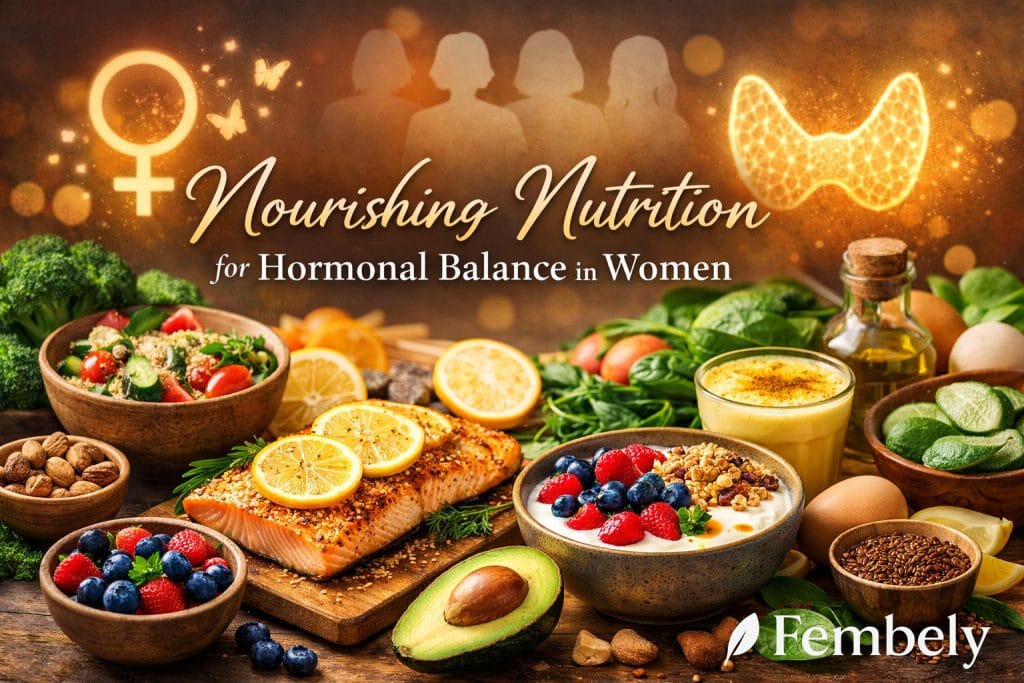
Nourishing Nutrition for Hormonal Balance in Women
Balanced diet for female hormones is rarely discussed in the calm, realistic way women actually need. Too often, hormonal health is framed as something broken that must be fixed quickly — with rigid food rules, unrealistic meal plans, or a sense of quiet guilt when life inevitably interferes. In reality, female hormones respond less to perfection and more to consistency, rhythm, and emotional safety around food. What truly shapes hormonal balance is not one “clean” week or a sudden reset, but the daily negotiations between energy, stress, appetite, mood, and nourishment.
A woman’s body does not operate on straight lines. Hormones rise and fall, appetite shifts subtly across the month, and emotional needs intertwine with physical ones. A balanced diet for female hormones must respect these fluctuations instead of fighting them. It must feel livable on busy mornings, comforting on exhausting evenings, and supportive during those quiet weeks when motivation dips without explanation. ✨
Why Hormonal Balance Is More About Rhythm Than Restriction
Hormonal health is often misunderstood as something that demands control. In practice, control is usually what disrupts it.
When eating becomes rigid — constant calorie tracking, fear of certain food groups, or long stretches of undereating — the body interprets scarcity. Female hormones are particularly sensitive to this signal. Cycles may become irregular, energy unstable, and emotional resilience thinner. A balanced diet for female hormones works not because it eliminates foods, but because it reassures the body that nourishment is reliable.
Many women notice subtle signs long before anything feels “wrong”: afternoon crashes, cravings that feel louder than hunger, sleep that looks normal but doesn’t feel restorative. These are often early messages that nutritional rhythm is off — not dramatic failures, but gentle warnings asking for steadiness rather than discipline.
💫
The Hidden Hormonal Cost of Skipping Meals
Skipping meals is often normalized, even praised. Busy schedules, delayed breakfasts, or the habit of “just grabbing coffee” can quietly destabilize hormones over time.
Female hormones rely on consistent blood sugar to stay regulated. Long gaps between meals can trigger stress responses, leading to increased cortisol activity — a hormone that easily overshadows others when it remains elevated. This doesn’t always show up as anxiety; sometimes it looks like irritability, foggy thinking, or feeling emotionally flat.
A balanced diet for female hormones does not demand large meals or constant eating. It asks for predictability. Even small, well-timed meals can restore hormonal trust. What matters is not how little one can eat, but how supported the body feels throughout the day.
✨
What to Eat and What to Avoid for a Balanced Diet for Female Hormones
A balanced diet for female hormones focuses on stabilizing blood sugar, supporting natural hormone production, and reducing unnecessary stress on the body. Instead of extreme restriction, the goal is nourishment that feels steady, satisfying, and realistic.
Foods to Eat for Hormonal Balance
1. Whole, slow-digesting carbohydrates
Carbohydrates are essential in a balanced diet for female hormones because they help regulate cortisol and support reproductive hormones. Choose options that digest gradually to avoid energy crashes.
Examples include whole grains, root vegetables, legumes, and fruits paired with protein or fat.
2. Quality protein at every meal
Protein provides the building blocks for hormone signaling and helps maintain stable appetite throughout the day. Moderate portions spread evenly across meals are more supportive than very high-protein, low-carb patterns.
3. Healthy dietary fats
Hormones are synthesized from fats. Including natural fat sources consistently helps the body feel safe enough to maintain hormonal balance. Fats also improve satiety and reduce sugar cravings.
4. Fiber-rich vegetables
Vegetables support digestion and help the body process excess hormones efficiently. A variety of colors throughout the week matters more than eating large amounts at once.
5. Regular meals and snacks
Timing matters just as much as food choice. Eating regularly supports blood sugar stability, which is foundational to any balanced diet for female hormones.
✨
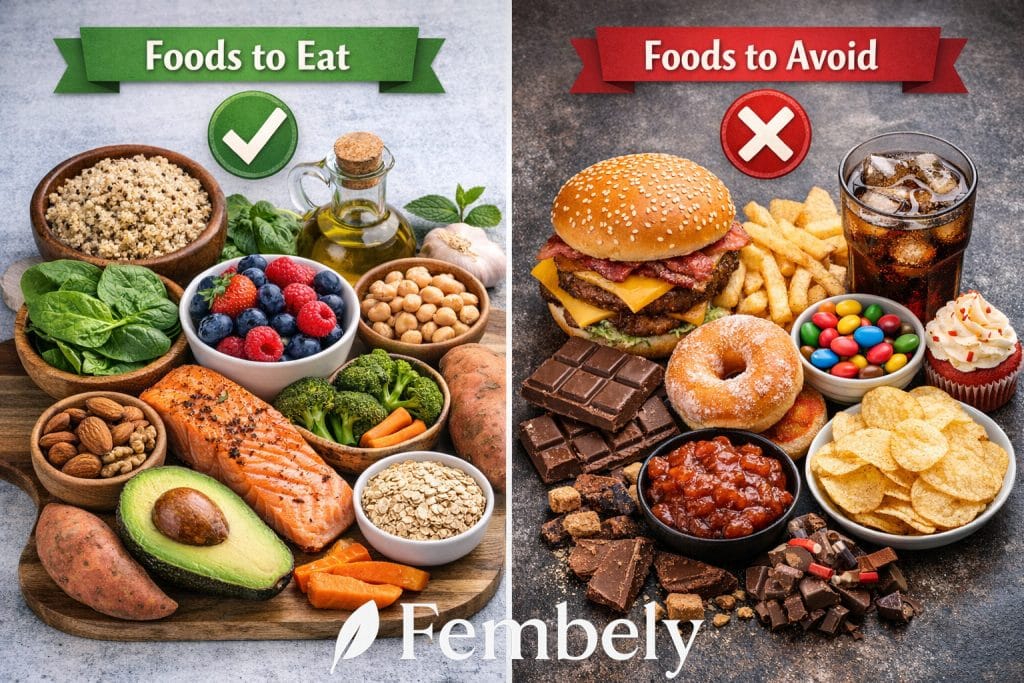
Foods to Limit or Avoid
Highly processed foods
These often disrupt appetite signals and contribute to blood sugar swings, making hormonal balance harder to maintain.
Excessive sugar on its own
Sugar isn’t the enemy, but consuming it without protein or fat can increase hormonal stress responses.
Very low-calorie or restrictive eating patterns
Undereating is one of the most common reasons female hormones become irregular. Consistency matters more than “clean” eating.
Skipping meals frequently
Long gaps between meals can elevate stress hormones and interfere with natural hormonal rhythms.
💫
Sample 7-Day Balanced Diet for Female Hormones
This example shows how a balanced diet for female hormones might look in real life. Portions should be adjusted based on hunger and lifestyle.
Day 1
Breakfast: Whole-grain toast with eggs and vegetables
Lunch: Grain bowl with legumes, greens, and olive oil
Dinner: Baked protein, roasted vegetables, and carbohydrates
Day 2
Breakfast: Yogurt with fruit, nuts, and seeds
Lunch: Balanced salad with protein, grains, and dressing
Dinner: Stir-fried vegetables with protein and rice
Day 3
Breakfast: Oatmeal with berries and nut butter
Lunch: Soup with beans, vegetables, and bread
Dinner: Protein, sweet potatoes, and greens
Day 4
Breakfast: Smoothie with protein, fruit, and fats
Lunch: Wrap with protein, vegetables, and sauce
Dinner: Pasta with vegetables and protein
Day 5
Breakfast: Eggs, vegetables, and toast
Lunch: Grain-based salad with fats and protein
Dinner: Slow-cooked meal with carbohydrates
Day 6
Breakfast: Yogurt bowl with grains and fruit
Lunch: Leftovers with balanced macros
Dinner: Comfort-style meal, eaten mindfully
Day 7
Breakfast: Flexible, hunger-led breakfast
Lunch: Nourishing meal out or at home
Dinner: Light but satisfying balanced plate
Carbohydrates: The Most Misunderstood Hormonal Ally
Carbohydrates are frequently framed as optional or indulgent. For female hormones, they are neither.
When carbohydrates disappear, hormones often react first. Low carbohydrate intake can interfere with signals that regulate ovulation, thyroid activity, and mood stability. This doesn’t mean every meal needs to revolve around them, but it does mean they cannot be treated as an afterthought.
In a balanced diet for female hormones, carbohydrates serve as grounding elements. They help regulate stress responses, support restful sleep, and prevent the emotional volatility that often appears when the body senses energy restriction. The key is not quantity alone, but context — pairing carbohydrates with protein and fats to create steadiness rather than spikes.
💫
Recommended Reading:
Free Diet Plan for Obese Female
Fats and Hormones: A Quiet Partnership
Hormones are built from fat, yet fat is still approached with hesitation. The irony is subtle but powerful.
Adequate dietary fat supports the production and signaling of female hormones. When fat intake drops too low, the body adapts by conserving — often at the expense of reproductive and emotional balance. Dry skin, low libido, and persistent fatigue can all be quiet reflections of this imbalance.
A balanced diet for female hormones integrates fats naturally, without obsession. Not excessive, not avoided — simply present. When fats are included consistently, satiety improves, cravings soften, and the body receives the message that it is safe to function fully.
✨
Protein: Stability Without Pressure
Protein is often discussed in extremes — either neglected or aggressively prioritized. Neither serves hormonal balance particularly well.
Female hormones respond best to moderate, evenly distributed protein intake. Large, protein-heavy meals paired with long fasting periods can feel physically grounding at first but emotionally draining over time. On the other hand, consistently low protein intake may leave hormones without the building blocks they need for repair and regulation.
In a balanced diet for female hormones, protein appears quietly and reliably. It stabilizes energy, supports neurotransmitter balance, and reduces the intensity of cravings — not by force, but by sufficiency.
💫
Emotional Eating Is Not a Hormonal Failure
One of the most damaging myths around hormonal health is the idea that emotional eating represents weakness or lack of control. In truth, emotional eating is often the body’s attempt to self-regulate.
During hormonal shifts — particularly in the second half of the cycle — appetite may increase, and comfort foods may feel more appealing. This is not a flaw; it is physiology meeting emotion. Suppressing these signals often backfires, leading to stronger cravings later.
A balanced diet for female hormones allows room for emotional nourishment. When food choices are flexible rather than moralized, the body relaxes. Hormones respond not only to nutrients, but to the absence of stress around eating.
✨
Why “Perfect” Diets Rarely Support Female Hormones
Highly structured diets often promise hormonal balance, yet many women find themselves more tired, colder, and emotionally reactive after following them strictly.
The problem is not discipline — it is mismatch. Female hormones thrive on adaptability. Life includes social meals, disrupted sleep, fluctuating workloads, and emotional transitions. A diet that collapses under these conditions is not balanced, no matter how clean it looks on paper.
A balanced diet for female hormones must flex with reality. It should support the body on calm days and stressful ones alike. This flexibility is not indulgence; it is biological intelligence.
💫
The Subtle Power of Regularity
Regularity sounds unglamorous, yet it is one of the most powerful tools for hormonal stability.
Eating at roughly consistent times, sleeping in predictable windows, and allowing meals to feel complete rather than rushed all send calming signals to the endocrine system. Over time, this steadiness can soften symptoms that once felt mysterious — mood swings, energy dips, or digestive discomfort.
A balanced diet for female hormones is not built on novelty. It is built on repetition that feels supportive rather than boring. The body does not crave constant optimization; it craves reliability.
✨
When Listening to the Body Feels Confusing
“Listen to your body” is often offered as advice, yet rarely explained. For many women, hunger cues have been muted or distorted by years of dieting, stress, or external rules.
Rebuilding trust with appetite takes time. Some days hunger is clear; other days it is tangled with emotion, fatigue, or habit. This does not mean intuition is broken — it means it needs consistency to recalibrate.
Within a balanced diet for female hormones, structure and intuition coexist. Gentle meal frameworks provide safety, while flexibility allows awareness to return gradually.
💫
Recommended Reading:
The Impact of Stress on Women: What No One Talks
Hormonal Balance Is Not Linear — And That Matters
Progress in hormonal health is rarely obvious week to week. Improvements may appear as fewer extreme days rather than constant wellness. Emotional resilience may return before physical symptoms resolve, or vice versa.
Expecting linear results often leads to unnecessary self-doubt. A balanced diet for female hormones supports gradual stabilization, not instant transformation. The goal is not perfection, but resilience — the ability to recover more quickly when life disrupts routine.
✨
The Long-Term Relationship Between Food and Female Hormones
Hormones respond to patterns, not isolated efforts. What matters most is not what happens after a “reset” or during a particularly motivated phase, but what remains when enthusiasm fades.
A balanced diet for female hormones becomes sustainable when it stops feeling like a project and starts feeling like care. When meals are allowed to be nourishing rather than performative, the body often responds with subtle but meaningful shifts: steadier moods, improved energy, a calmer relationship with food.
💫
A Quiet, Powerful Conclusion
Hormonal balance does not demand strict rules, punishment, or constant vigilance. It asks for nourishment that feels safe, regular, and emotionally supportive. A balanced diet for female hormones is less about control and more about respect — for cycles, appetite, mood, and the realities of modern life.
When food becomes a stabilizing presence rather than a source of tension, hormones often find their footing naturally. This kind of balance is not dramatic, but it is deeply sustainable — and it changes how a woman feels in her body over time.
For more thoughtful, experience-driven insights into women’s health, lifestyle, and modern femininity, explore the editorial world of Fembely at https://fembely.com/ — where balance is approached with intelligence, nuance, and grace ✨